
Characteristics
The next step is to roll and assign Base Characteristics. These Characteristics determine bonuses to all Skills, therefore it is recommended to assign Characteristics in descending order relevant to the skills you desire your character to be proficient with. Your Profession can assist in determining which skills you can focus on.
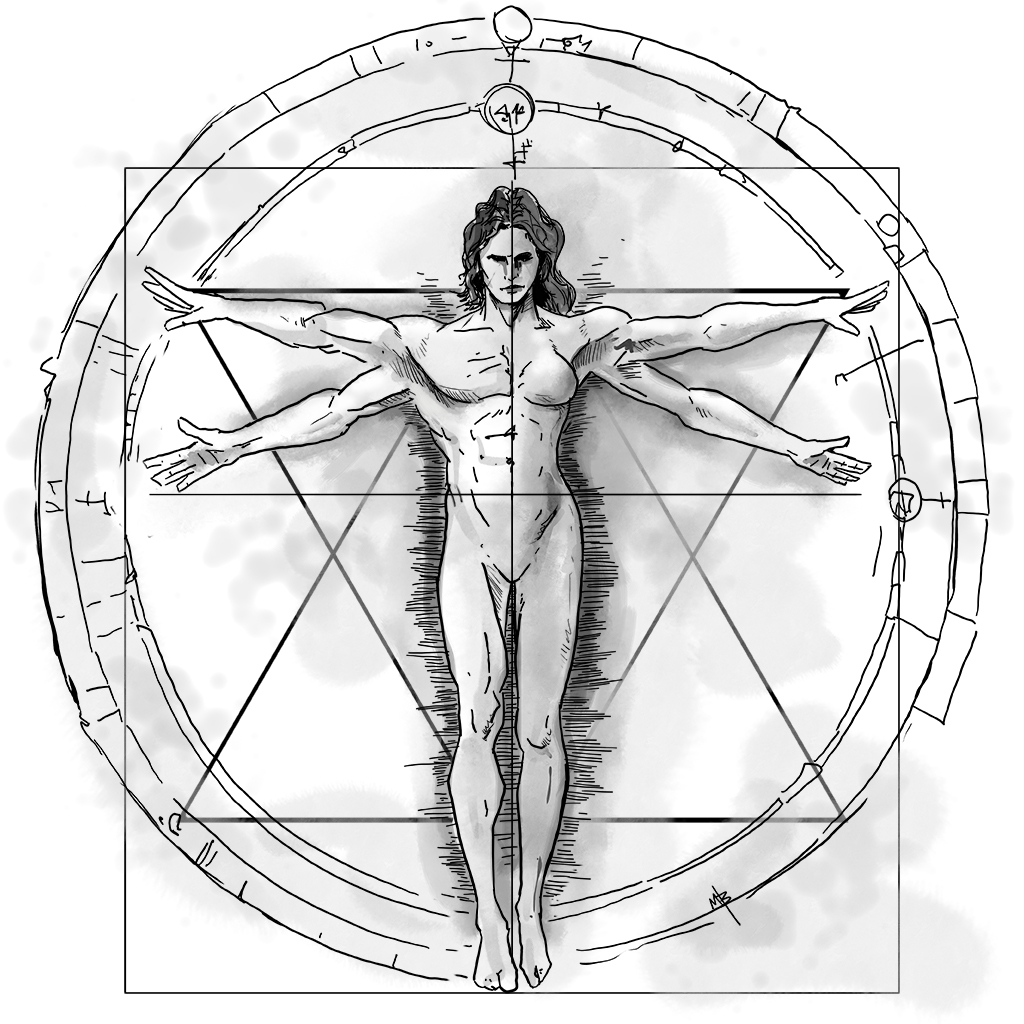
Your character is measured and defined by a set of characteristics, values that represent their physical and mental capabilities. Higher characteristicA hero's base physical and mental abilities. More numbers are usually better (though a high SIZSize defines height, weight, and bulk. There is no SIZ-assoc... More can work against you for stealth). CharacteristicA hero's base physical and mental abilities. More values indicate raw natural gifts your character has. CharacteristicA hero's base physical and mental abilities. More values can change over the course of play. Injuries or adverse conditions can decrease characteristics, while training, exertion, and conditioning can increase them.
- Physical characteristics (STR, CON, SIZSize defines height, weight, and bulk. There is no SIZ-assoc... More, DEX, and SOC) have a maximum of 21 for heroes.
- Mental characteristics (INT and ACU) can usually be raised without limits.
- Under most conditions 3 is the lowest value for any characteristicA hero's base physical and mental abilities. More other than INT, which has a minimum value of 8.
Strength (STR)
Strength measures brawn and raw muscle power. In combat, STR limits what kind of weapons a character can wield, as well as helping determine how much extra damage (if any) they inflict with any hit. STR can be increased through exercise, while certain injuries and diseases can permanently reduce STR. A character with STR 0 is an invalid, unable to rise from their bed.
Constitution (CON)
Health, vigor, and vitality are all measured by Constitution. CON determines how well a character can resist fatigue, poison, disease, drowning, and other hardships, and is a factor in calculating hit pointsA measure of the relative health of your character, represen... More. CON can be increased through conditioning. Diseases, poisons, and some injuries can temporarily or permanently reduce CON. If a character’s CON falls to or below 0 they immediately die.
Size (SIZ)
Size defines height, weight, and bulk. A character’s SIZSize defines height, weight, and bulk. There is no SIZ-assoc... More, as body mass, helps determine hit pointsA measure of the relative health of your character, represen... More and damage modifierA modifier to rolled damage due to above-average Strength an... More. Height and weight ranges are guidelines, not hard limits. SIZSize defines height, weight, and bulk. There is no SIZ-assoc... More represents physical presence, bulk, and mechanical impact — a tall but spindly creature may share a SIZSize defines height, weight, and bulk. There is no SIZ-assoc... More with a squat, muscular one, and a dense creature may have a deceptively high SIZSize defines height, weight, and bulk. There is no SIZ-assoc... More compared to its physical appearance!
Of note, SIZSize defines height, weight, and bulk. There is no SIZ-assoc... More is based on the species, so it can range in any direction, only limited by the SG’s limitation of playable species.
Size Chart
| Base SIZSize defines height, weight, and bulk. There is no SIZ-assoc... More | Rating | Height | Wgt | Modifier | Species |
| 1 | Fine | <11 inches | 0-10 lbs. | +20% to Hide, Stealth, and Dodge Skills | Fae |
| 2-3 | Tiny | 1’ – 2.9’ (12-35 inches) | 8-30 lbs. | +15% to Hide, Stealth, and Dodge Skills | Boggart, Miglin |
| 4-6 | Small | 3’ – 4.4’ (36-52 inches) | 16-60 lbs. | +10% to Hide, Stealth, and Dodge Skills | Elfling, Goblin |
| 7-19 | Medium | 4.5’ – 7’ (54-84 inches) | 55-225 lbs. | Standard Size | Teran, Dworv, Dweran, Elf, |
| 20-30 | Large | 8’ – 14’ (96-168 inches) | 220-500 lbs. | -10% to Hide, Stealth, and Dodge Skills | Ogre, Orog |
| 31-50 | Huge | 12’ – 24’ | 400-4000 lbs. | -15% to Hide, Stealth, and Dodge Skills | Giant |
| 51+ | Gigantic | 18’+ | 3500+ lbs. | -20% to Hide, Stealth, and Dodge Skills | Dragon |
Intelligence (INT)
Representing reason, mental acuity, and wits, INT measures how well a character learns, remembers, and analyzes information. INT has no fixed maximum and can conceivably rise indefinitely through study and mental exercise. Wounds to the head, prolonged exposure to harmful drugs, or certain types of diseases can reduce INT. A character with an INT 0 has been reduced to a vegetative state, unable to survive independently. Vegetative creatures can be sustained with constant aid of another creature and a successful Medicine check every day.
Acumen (ACU)
Acumen reflects a character’s abilitySomething a character can do or feel, whether a skill, a pas... More to make sound judgments, quick decisions, and insightful observations. It represents intuition, and shrewdness and measures a character’s spiritual sensitivity—their capacity to sense unseen forces, grasp deeper truths, and connect with the mystical or divine. ACU is essential for those who rely on instinct, wisdom, or spiritual awareness. ACU serves as the determiner for initial Spirit Points and initial Horror An optional system where your character’s mental health is ... More Resistance. Like INT, human ACU has no set maximum, and can rise indefinitely. Magical influences can reduce ACU (temporarily or permanently) and some magic is fueled by the permanent sacrifice of points of ACU. For magic (see Chapter 4: Magic). ACU determines initial mana when a spellcasting Talent (any Talent that grants mana) is chosen, therefore a character with higher ACU will have the abilitySomething a character can do or feel, whether a skill, a pas... More to cast more spells without rest. Starting mana is ACU/2. A character whose ACU points reaches 0 goes into a coma and does not wake up until they have gained back one ACU.
Dexterity (DEX)
Dexterity score measures balance, agility, speed, and deftness. Characters rely upon DEX when reacting to an attack, climbing, performing delicate work, or moving stealthily. Injuries or nerve diseases can reduce DEX, while rigorous training can quicken reflexes and improve balance. A character with DEX 0 is utterly immobile.
Social (SOC)
Social determines how likable or attractive a character is to others, and is based as much on presence, personality, and demeanor as simple physical appearance. SOC is used to measure first impressions and indicates how eager others will be to associate with someone, through physical attraction or an appealing personality. SOC can be raised through physical conditioning, cosmetic surgery, or careful application of grooming and etiquette. It could even be improved by a small amount by possession of particularly impressive equipment. It can also be reduced through injury or disease. A character with a SOC 0 is utterly odious, provoking disgust or even violence from all who encounter them.
Obtaining Base Characteristic Points
To get your Base CharacteristicA hero's base physical and mental abilities. More Points, there are two methods: Point Buy or Random. You and your StoryGuideThe director, or guide for the game, who helps you create ch... More should decide which is best for your campaign.
Point Buy Character Creation (Primary): Players can purchase characteristicA hero's base physical and mental abilities. More points from a pool. A CharacteristicA hero's base physical and mental abilities. More Point Calculator can be found at: www.d100srd.com/point-based-characteristic-calculator/
- All base characteristics (STR, CON, INT, ACU, DEX, and SOC) begin at 10.
- You have 24 points to spend on characteristics. This is the equivalent of the ‘normal’ power level for a campaign. No initial characteristicA hero's base physical and mental abilities. More can be raised to higher than 19.
- Each point of STR, CON, or SOC costs 1 point up to 15, and 2 points for 16-19.
- Each point of DEX, INT, and ACU costs 1 point up to 13, 3 points up for 14-16, and 4 points for 17-19.
- You can choose to lower your starting characteristics below the starting value of 10, to a minimum of 3.
- For each point of STR, CON, or SOC you reduce below 10, you get 1 point to spend on other characteristics.
- For every point of DEX, INT, and ACU you reduce below 10, you get 2 points back.
- For SIZSize defines height, weight, and bulk. There is no SIZ-assoc... More: Elfings roll 1d3+3, Dworvs roll 2d6 +4; Terans, Elves, Fauns, and Dwerans roll 2d6+6, and Orogs 1d3+19.
- Only with a StoryGuide’s permission can you raise or lower a starting characteristicA hero's base physical and mental abilities. More beyond the range of 7–19.
Random Roll Character Creation: Players roll dice and assign the rolls to a CharacteristicA hero's base physical and mental abilities. More.
- Roll 3D6 and write the result down. Do this 4 more times so you have five total unassigned stats. Then, assign each of these rolls to one of the following base characteristics: Strength (STR), Constitution (CON), Acumen (ACU), Dexterity (DEX), and Social (SOC). Enter the results in the appropriate places on your character sheet.
- Roll 2D6+6 for the Intelligence (INT).
- For SIZSize defines height, weight, and bulk. There is no SIZ-assoc... More: Elfings roll 1d3+3, Dworvs roll 2d6 +4; Terans, Elves, Fauns, and Dwerans roll 2d6+6, and Orogs 1d3+19.
These numbers provide the statistics of your character, determining which characteristics the character is strong or weak in.
- If you wish, redistribute up to 3 points between your characteristics between STR, DEX, CON, ACU, and SOC.
- No characteristicA hero's base physical and mental abilities. More (other than SIZSize defines height, weight, and bulk. There is no SIZ-assoc... More) can begin at more than 19 points.
- If you aren’t satisfied with the characteristics you have, and your StoryGuideThe director, or guide for the game, who helps you create ch... More approves, you can start over.
Characteristic Rolls
CharacteristicA hero's base physical and mental abilities. More Rolls are used for Saves, Heroic Actions, and other challenges that may be more generic than a Skill check. By now, you should know what your final characteristics are, but if not, hold off on this step until you’ve finalized them. Each has a place on the character sheet.
- Multiply STR×5 for your STR roll.
- Multiply CON×5 for your CON roll.
- Multiply INT×5 for your INT roll.
- Multiply ACU×5 for your ACU roll.
- Multiply DEX×5 for your DEX roll.
- Multiply SOC×5 for your SOC roll.
Some challenges do not intuitively map to particular skills. Can a hunter stay awake in a blind all night waiting for their quarry? Can a hardened detective piece together the tantalizing clue hidden in the scraps of evidence? In these situations, your StoryGuideThe director, or guide for the game, who helps you create ch... More can call for a characteristicA hero's base physical and mental abilities. More roll: a D100A d100 is a 100-sided die. In SagaBorn it is used to determi... More roll against an appropriate characteristicA hero's base physical and mental abilities. More, multiplied by another number. Your StoryGuideThe director, or guide for the game, who helps you create ch... More decides which multiplier to use based on the difficulty of the task.
Strength Roll (Base STR×5)
Most feats of strength involve a Strength roll. Strength rolls can also be used as an easyYour skill is doubled when a task is easier than normal. Eas... More way to determine things such as whether a character can pull themselves up onto a ledge.
Constiutution Roll (Base CON×5)
Constitution rolls measure endurance. Use a Constitution roll whenever physical or intestinal fortitude is in question. To list a few examples, a Constitution roll might determine whether a character can stay awake all night, or endure seasickness, ill-prepared food, or strong drink with no ill effectsEffects are conditional modifiers due to actions against the... More.
Intelligence Roll (Base INT×5)
An Intelligence roll represents the abilitySomething a character can do or feel, whether a skill, a pas... More to make clever guesses, informed hunches, or reasonable deductions based upon nothing but observation and raw intellect. When no skill seems appropriate, an Intelligence roll can show understanding of a concept or the abilitySomething a character can do or feel, whether a skill, a pas... More to unravel a puzzle. Memory is also part of the Intelligence roll: use an Intelligence roll to remember an important detail, retrace steps through a labyrinth, or memorize a lengthy formula.
Your StoryGuideThe director, or guide for the game, who helps you create ch... More may also allow an Intellect roll if you are stalled, getting you back on track by revealing a hidden meaning of some already uncovered clue, or letting them know that something ‘doesn’t quite seem right’ about a particular person, place, or thing. This type of Intelligence roll should only be granted at your StoryGuide’s discretion and is not generally solicited by players.
Your StoryGuideThe director, or guide for the game, who helps you create ch... More may also require an Intelligence roll if you wish to have your character think or behave in a manner that represents player knowledge vs. character knowledge. If a character is a primitive hunter encountering technology, for example, your StoryGuideThe director, or guide for the game, who helps you create ch... More may require an Intelligence roll for them to be able to grasp basic concepts of the item, even if the player automatically knows what it is based on its description.
Acumen Roll (Base ACU×5)
A Spirit roll is a balance of expertise, an inner intuition, and a bit of luck rolled into it. Acumen rolls are often used as saves vs mind affecting spells or supernatural effectsEffects are conditional modifiers due to actions against the... More.
Dexterity Roll (Base DEX×5)
Whenever a feat of deftness, balance, or agility is called for and no appropriate skill exists, use a Dexterity roll to measure success. A Dexterity roll might, for example, determine if a character can keep their balance on a heaving ship’s deck, gather up all the pieces of a broken vase in a hurry, run carrying a precious elixir without spilling any, or grab the vine at the edge of a cliff before falling off.
Social Roll (Base SOC×5)
Use Social rolls to adjudicate interpersonal reactions not covered by an existing skill. Making a good first impression, seducing an acquaintance, or becoming the person a group turns to first for guidance are all good uses for a Social roll. If a character is standing outside a trendy night club wanting to be let in, a successful Social roll will get them noticed and waved through the door.
Derived Characteristics
Now it’s time for the derived characteristics: damage modifierA modifier to rolled damage due to above-average Strength an... More, hit pointsA measure of the relative health of your character, represen... More, spirit points and experience bonus1/2 INT, added to rolls when leveling up. More. If you’re using optional systems, you should also determine any additional derived characteristics with help from your StoryGuideThe director, or guide for the game, who helps you create ch... More. Write the results on your character sheet.
- Damage ModifierA modifier to rolled damage due to above-average Strength an... More: Add Base STR+SIZSize defines height, weight, and bulk. There is no SIZ-assoc... More and find the damage modifierA modifier to rolled damage due to above-average Strength an... More corresponding to your character’s total on the Damage ModifierA modifier to rolled damage due to above-average Strength an... More table (under Definitions below).
- Hit PointsA measure of the relative health of your character, represen... More: Add Base CON+SIZSize defines height, weight, and bulk. There is no SIZ-assoc... More. Write that number in the Hit PointsA measure of the relative health of your character, represen... More box on your character sheet and write it below. This is your character’s maximum hit pointsA measure of the relative health of your character, represen... More. If you are hurt, you will gain Wounds, which can not exceed your Max HPA measure of the relative health of your character, represen... More without dire consequences.
- Spirit Points: These fuel some talentsExtraordinary abilities that define your character. More, adding of Boons, and some specialA special success if the roll is equal to or less than 1/5 t... More abilities.
- Experience Bonus1/2 INT, added to rolls when leveling up. More: Your character’s experience bonus1/2 INT, added to rolls when leveling up. More is equal to 1/2 their Base INT, rounded up.
- Movement Speed (Speed and MOV): Your character’s Movement Speed measures how fast they are. Most medium creatures have a movement speed of 25’.
- Horror An optional system where your character’s mental health is ... More: Your Base ACU×5 is your Max Horror An optional system where your character’s mental health is ... More Resistance total. In play, if you gain Horror An optional system where your character’s mental health is ... More, it lowers your Horror An optional system where your character’s mental health is ... More Resistance. When your character reaches 0 Horror An optional system where your character’s mental health is ... More Resistance, they are considered unplayable.
Derived Characteristics in Depth
In addition to characteristics (and their attendant characteristicA hero's base physical and mental abilities. More rolls), a character is also defined by a set of derived characteristics, figured from their characteristics. If injuries, magic, or other factors increase or decrease a characteristicA hero's base physical and mental abilities. More, all characteristics derived from that characteristicA hero's base physical and mental abilities. More immediately change to reflect the new value.
For example, your character (CON 16, SIZSize defines height, weight, and bulk. There is no SIZ-assoc... More 14, HPA measure of the relative health of your character, represen... More 15) falls victim to a deadly poison, which reduces their CON value to 10. Your character’s maximum hit pointsA measure of the relative health of your character, represen... More immediately drop from 15 (16+14=30, divided to 15) to 12 (10+14=24, divided to 12). Additionally, their major wound total drops from 8 to 6. If wounds had already brought your character lower than 12 hit pointsA measure of the relative health of your character, represen... More, they would not take any additional damage, but they are limited to the 12 hit point maximum until their original CON is restored.
Damage Modifier (Base STR+SIZ, see table)
Bigger, stronger characters and creatures are more powerful in physical combat, inflicting more damage than average with each strike. Smaller, weaker beings inflict less damage with their attacks. The damage modifierA modifier to rolled damage due to above-average Strength an... More reflects this advantage, expressed in terms of damage dice added or subtracted from the damage of successful attacks.
A character adds their full damage modifierA modifier to rolled damage due to above-average Strength an... More to all hits with brawling or melee weapons. In the case of a negative damage modifierA modifier to rolled damage due to above-average Strength an... More, subtract the appropriate dice from any inflicted damage. If the total is 0 or less, the blow is too soft to inflict any harm. An attack never does negative damage, so if the modified damage roll goes below 0, count it as 0.
Missile weapons don’t allow a character to use their full damage modifierA modifier to rolled damage due to above-average Strength an... More. If your character’s damage modifierA modifier to rolled damage due to above-average Strength an... More is positive, divide the results in half (round up) when using a thrown weapon or a bow. If the damage modifierA modifier to rolled damage due to above-average Strength an... More is negative, keep the modifier as is. Self-propelled weapons (firearms, energy missile weapons, etc.) do not receive a damage modifierA modifier to rolled damage due to above-average Strength an... More.
To calculate damage modifierA modifier to rolled damage due to above-average Strength an... More, add the character’s STR and SIZSize defines height, weight, and bulk. There is no SIZ-assoc... More, and find the result on the Damage ModifierA modifier to rolled damage due to above-average Strength an... More table (following).
Damage ModifierA modifier to rolled damage due to above-average Strength an... More Table
| STR+SIZSize defines height, weight, and bulk. There is no SIZ-assoc... More | STR+SIZSize defines height, weight, and bulk. There is no SIZ-assoc... More % | Damage ModifierA modifier to rolled damage due to above-average Strength an... More | STR+SIZSize defines height, weight, and bulk. There is no SIZ-assoc... More | STR+SIZSize defines height, weight, and bulk. There is no SIZ-assoc... More Roll | Damage ModifierA modifier to rolled damage due to above-average Strength an... More | |
| 2–12 | 10-60 | -2 | 73–88 | 365-440 | +4D6 | |
| 13–16 | 65-80 | -1 | 89–104 | 445-520 | +5D6 | |
| 17–24 | 85-120 | None | 105–120 | 525-600 | +6D6 | |
| 25–32 | 125-160 | +1D4 | 121–136 | 605-680 | +7D6 | |
| 33–40 | 165-200 | +1D6 | 137–152 | 685-760 | +8D6 | |
| 41–56 | 205-280 | +2D6 | 153–168 | 765-840 | +9D6 | |
| 57–72 | 285-360 | +3D6 | Each +16 | Additional +1D6 |
Hit PointsA measure of the relative health of your character, represen... More (Base CON + SIZSize defines height, weight, and bulk. There is no SIZ-assoc... More)
Hit pointsA measure of the relative health of your character, represen... More represent your character’s capacity to withstand punishment and physical injury. When you take damage, you subtract hit pointsA measure of the relative health of your character, represen... More from your total. Calculate maximum hit pointsA measure of the relative health of your character, represen... More by adding your character’s CON and SIZSize defines height, weight, and bulk. There is no SIZ-assoc... More scores.
Your character loses consciousness when their wounds (both lethal and subdual) is greater than their hit pointsA measure of the relative health of your character, represen... More, and if their hit pointsA measure of the relative health of your character, represen... More reach -10, they die at the end of the following round. Lost hit pointsA measure of the relative health of your character, represen... More heal naturally at a rate of 1d4+1 points per 4 hours of rest, though medical attention can speed recovery.
Spirit Points (Base ACU)
Spirit Points (SP) represent your character’s vital essence, their reserves of spiritual or life energy. Your character spends spirit points to cast or resist spells as well as some specialA special success if the roll is equal to or less than 1/5 t... More abilities. Your character’s maximum Spirit Points are usually equal to their ACU characteristicA hero's base physical and mental abilities. More. Generally, spent SP regenerates at a rate of 1 per hour of sleep or total rest, or 1 for every two hours of normal activity. If your character is engaged in strenuous activity, they cannot regain SP. When your character’s Spirit Point total falls to 0, they are completely exhausted and faint until regaining at least 1 spirit point. You cannot have negative spirit points.
Unlike hit pointsA measure of the relative health of your character, represen... More, Spirit Points can climb above the maximum for brief times under certain conditions.
Experience Bonus (1/2 Base INT)
The smarter a character is, the faster they can learn, especially under stress. To determine their experience bonus1/2 INT, added to rolls when leveling up. More, divide their INT by 2, rounding up. Add the experience bonus1/2 INT, added to rolls when leveling up. More to the learning roll for each experience check your character makes to improve a skill or characteristicA hero's base physical and mental abilities. More. Consult Chapter 5: System and Skill Improvement.
Movement Speed (MOV)
Movement is based on the size of a character. This average movement is how far a character can move as a Move Action or Standard Action.
Average Movement Rates by SIZSize defines height, weight, and bulk. There is no SIZ-assoc... More
| Base SIZSize defines height, weight, and bulk. There is no SIZ-assoc... More | 1 | 2-3 | 4-6 | 7-19 | 20-25 | 26-30 | 31-50 |
| MOV (Speed) | 10’ | 15’ | 20’ | 25’ | 30’ | 35’ | 40’ |
Movement rates are described further in Movement Rates in Chapter 5: System.
Horror Resistance Points (Max = ACU×5)
As described in Horror An optional system where your character’s mental health is ... More, Horror An optional system where your character’s mental health is ... More Resistance (HR) represents your character’s mental and emotional fortitude, and their abilitySomething a character can do or feel, whether a skill, a pas... More to withstand shock, terror, and cosmic awfulness. Your character’s base (max) HR points equal their Base ACU×5.
Whenever your character is exposed to a horrifying situation or mind-bending strangeness, they must roll D100A d100 is a 100-sided die. In SagaBorn it is used to determi... More against their current HR. If your character fails (or perhaps even if they succeed) they gain Horror An optional system where your character’s mental health is ... More.
Each point of Horror An optional system where your character’s mental health is ... More gained lowers the heroes Horror An optional system where your character’s mental health is ... More Resistance by the same amount (much like Wounds and Hit PointsA measure of the relative health of your character, represen... More). As the hero gains Horror An optional system where your character’s mental health is ... More they become more and more distraught. See Chapter 07.b for more on Horror An optional system where your character’s mental health is ... More.
Assigning Skills
Professions and Skills
To determine the starting skills for your character, reference the profession chosen during your Life Path. Professions are described fully later in this chapter. Your StoryGuideThe director, or guide for the game, who helps you create ch... More may restrict available professions, so ask before making this choice. Some professions provide specialA special success if the roll is equal to or less than 1/5 t... More advantages, such as the use of magic. Note these on the character sheet.
Once a profession has been chosen, determine the character’s professional skill point pool. This represents what your character has learned in that profession, whether through training or on-the-job experience. As always, skill points are added to any bonuses granted from previous steps and to the skill’s base chance.
The campaign’s power level determines the initial skill point pool. Your StoryGuideThe director, or guide for the game, who helps you create ch... More should have decided by now what kind of game they will run, and how powerful and competent player characters should be.
- Professional Skills: Allot 250 points to professional skills. No skill should begin higher than 75%. If a combination of bonuses increases the skill to more than 75% before this step, do not add any additional skill points.
For an original profession, allot the power level’s number of skill points, as above. Your StoryGuideThe director, or guide for the game, who helps you create ch... More may have some restrictions on how these skill points can be spent.
- Personal Skills: Once all professional skill points have been allocated, multiply your character’s INT×10 to determine their personal skill point pool. Spend these skill points on any skills you like, with your StoryGuide’s approval. Add points spent on a skill to its base chance, profession bonuses (if any), professional skill point allocations, and skill category bonuses (if any). The total must not exceed 75%.
- Skill Category Bonuses are added to each skill as well. This is discussed below.
Calculate the final rankings for all character skills from base chance, professional skill pool, personal skill pool, and the optional skill category bonuses. You might want to shift some points around at this time but try to keep the professional skill points and personal skill points separate.
Skill Category Bonuses
Each skill is grouped into skill categories. Each category is linked to one or more characteristics that are used to compute a skill category bonus for each category. To find your Skill Category Bonus, find the correct CharacteristicA hero's base physical and mental abilities. More and divide by two, rounding up.
Skill Category Modifiers
| Category | Primary |
| Combat skills | DEX/2 |
| Communication skills | SOC/2 |
| Dexterous skills | DEX/2 |
| Mental skills | INT/2 |
| Perception skills | ACU/2 |
| Physical skills | STR/2 |
Talents
TalentsExtraordinary abilities that define your character. More are specialA special success if the roll is equal to or less than 1/5 t... More abilities a character is either born with or gains through training. TalentsExtraordinary abilities that define your character. More are a way for players to customize their character, moving beyond their Profession skills. There are Archetype TalentsExtraordinary abilities that define your character. More which place a character on a specialized path. These TalentsExtraordinary abilities that define your character. More have prerequisites, but a character can have TalentsExtraordinary abilities that define your character. More in any Archetype they want, as long as they have the prerequisite Talent. Other TalentsExtraordinary abilities that define your character. More or more generalized, with only a point cost.
Players gain 3 points to spend on initial TalentsExtraordinary abilities that define your character. More when creating a character. The cost for each Talent is shown in parentheses beside each description. As characters go up in level, they gain additional Talent points from the StoryGuideThe director, or guide for the game, who helps you create ch... More as rewards. These points can be spent right away or saved up and spent on a higher-cost talent later. TalentsExtraordinary abilities that define your character. More are discussed in depth in Chapter 3.
Languages
A character begins the adventure with starting languages dependent on their INT. You have a 90% understanding of starting languages. More languages can be learned during your adventures, and after a month of studying any language (this can be a downtime activity) and a successful Research check (this can be aided by another Character’s Teach skill if they are 50% proficient with the language), you will start with a 10% skill in that language.
Restricted Languages
Some languages are considered ‘Restricted’ languages, meaning for various reasons these languages are obscure, spoken by few and tied to forgotten knowledge, magical traditions, or forbidden lore. Restricted Languages cannot be chosen at character creation without StoryGuideThe director, or guide for the game, who helps you create ch... More approval.
| INT: | 8 | 9 -14 | 15 -18 |
| # Languages | 1 | 2 | 3 |
Languages:
Common is spoken by almost all within the lands of Atheles. It is based on the original tongues of the first terans and has borrowed heavily from Elven.
Dworven is not connected to the other languages of Atheles. It was brought back into the world when the dworves awoke, and they claim it is the closest to the speech of the gods. It is a deep and harmonic language.
Eldar (Restricted) is the ancient language of the eldar, a people who were lost due to the genocide by Kaldrath. Eldar can not be a starting language, and can not be deciphered with any Language spell. There is something mystical about it, and any skill checks relating to it are difficultYour skill is halved when a task is harder than average, whi... More.
Elvish is the language of the elves, a language as old as the stars they claim. Their language was based on the ancient eldar language, but has long since deviated and become its own. It is a melodic and soothing language.
Fey is the language of the earth, or so the fauns claim. It is soft and whispering. The cultural language of elflings and fauns is Fey.
Goblin is a corruption of the fey language, filled with growls and whines. While some goblinoid creatures can speak common, they prefer their own language.
Ishian is the language of the southern empire of Ish. It comes from the same roots as Common, but while Common was influenced by elven, Ish was not.
Navirite is the speech of the Navirim, the other universe and plane of existence. Some call it the language of demons, while others note that it shares some similarities with Elven.
Northern is the language of Vanadhus, a Northwestern island kingdom that grew in isolation until their culture turned to shipbuilding, exploration, and trade.
Tirian is the language of the kingdom of Tyr. It was heavily influenced by traders and invaders from the lands of Tuya.
Uthgardian is the language of the Northeast. It was the language of Pardalor and has been mostly unused in the 700 years since the original Kingdom of Uthgard fell. Many ancient artifacts, books, and monuments in the North require knowledge of Uthgardian. The new Uthgardian Kingdom has reinstated the language as a sign of wealth and power, with the royalty and nobility using it once again.
Valantian (Restricted) is an ancient lost language of a people who passed from Atheles during the time of the Eldar. Little is known of them, though it is said they came from an advanced island kingdom which sunk into the sea.
Zhou is the language of the most powerful nation across the Ostiana Ocean.
Possessions and Equipment
Most characters have some sort of possessions, whether gear or weapons. Your profession describes your character’s starting equipment, funds, and other notes. All characters have at least a set of clothing appropriate to their profession.
Size and Distinctive Features
You may now choose to determine your character’s height and weight, based on SIZSize defines height, weight, and bulk. There is no SIZ-assoc... More. Generally, the SIZSize defines height, weight, and bulk. There is no SIZ-assoc... More range of 10–13 represents the range of average weight and height. A creature of SIZSize defines height, weight, and bulk. There is no SIZ-assoc... More 8 (normal minimum) is relatively small, and a creature of SIZSize defines height, weight, and bulk. There is no SIZ-assoc... More 30 is exceedingly large. You can define this as you wish, either through exact numbers for height and weight, or with descriptions such as “Tall” or “Slender.” See Size (SIZSize defines height, weight, and bulk. There is no SIZ-assoc... More) for more details.