
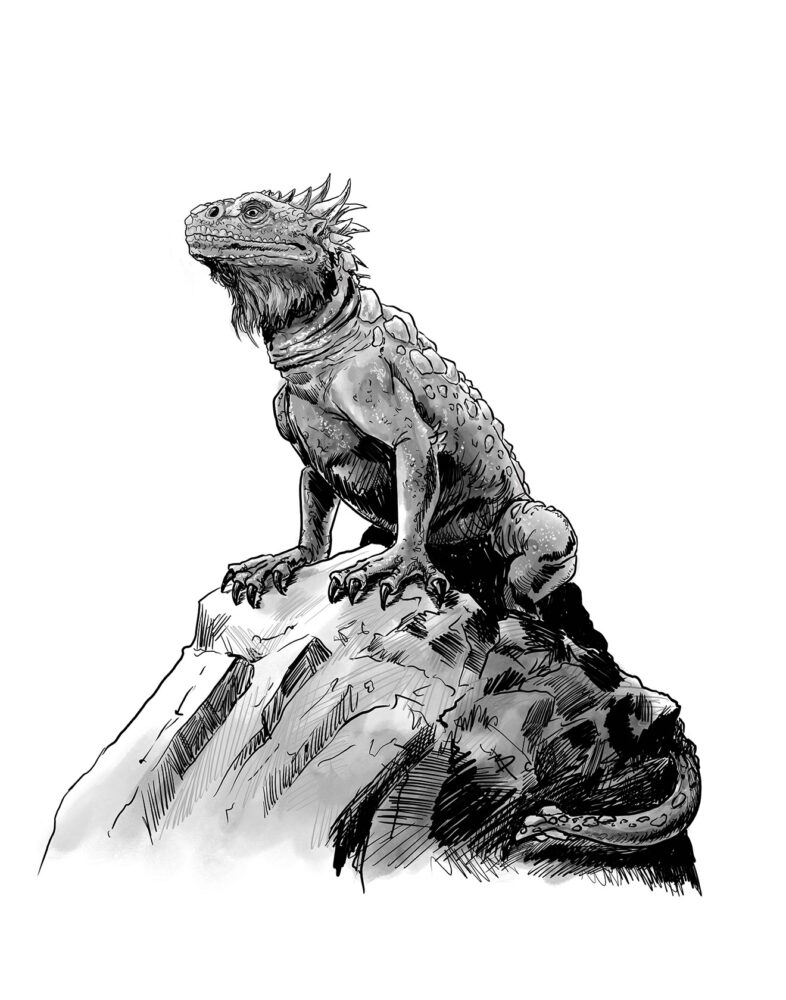
A basilisk is a giant reptile that can turn a flesh and blood creature to stone. They can grow up to 12 feet long from snout to tip of tail, though they have short legs and, other than their stony gaze, can only bite their prey.
It is thought that they were created by ancient wizard magic for guarding of places of power.
—Wolfram Buhl, Buc de Megichen Teir, (translated to the common tongue in 5763)
Basilisk
| Characteristics | CV | 5 | |||
| Stat | Score | % | Speed | 30’ | |
| STR | 18 | 90 | HPA measure of the relative health of your character, represen... More | 37 | |
| CON | 15 | 75 | Dmg Mod | 1d6 | |
| SIZSize defines height, weight, and bulk. There is no SIZ-assoc... More | 22 | 110 | AVThe numeric value representing how much damage armor absorbs... More | 5 | |
| INT | 4 | 20 | Class | Monster | |
| ACU | 6 | 30 | Type | Magical Beast | |
| DEX | 15 | 75 | Horror An optional system where your character’s mental health is ... More | 2/2d4 (If Turning to Stone) | |
| SOC | – | – | Treasure | Harvestables | |
- Attack: Bite* 80% 1d6+5+dm and (2) Claws 70% 1d6+5+dm
- Skills: Dodge 70%, Grapple 75%, Hide 65%, Listen 75%, Spot 75%, Stealth 65%
- SpecialA special success if the roll is equal to or less than 1/5 t... More: Stone Breath
- Weaknesses: Mirrors
- Habitat: Forests, Mountains, or Caves
- Encounter: single or a Pair
SIZSize defines height, weight, and bulk. There is no SIZ-assoc... More Note
Large (SIZSize defines height, weight, and bulk. There is no SIZ-assoc... More 22) = -10% to Hide/Stealth/Dodge (already applied)
*Bite The large mouth of a basilisk can only be dodged or parried with a shield; weapons are too small to block it.
Horror An optional system where your character’s mental health is ... More Anyone who begins to turn to stone suffers Horror An optional system where your character’s mental health is ... More at the unnatural transformation. 2/2d4
Stone Breath Contrary to belief, it is not the gaze of a basilisk that turns people to stone; it is its breath. Once every two rounds, as a Move or Standard action, a basilisk can breathe a 15’ cone of breath that can turn the skin of living creatures and plants into stone. A difficultYour skill is halved when a task is harder than average, whi... More Stamina check can resist the monster’s breath. If it is not resisted, the skin of the affected creature or plant begins to calcify, turning to a gray stone-like surface. In the first 2 rounds, the affected creature can only move at half speed. In the next two rounds, they can no longer walk, but they can complete other actions, but any action is difficultYour skill is halved when a task is harder than average, whi... More. In the following two rounds, they can speak but nothing more. They become encased in the calci-stone, alive but unable to move.
A creature petrified in this matter that is then coated (not just splashed) with fresh basilisk saliva (taken from a basilisk no more than 1 hour dead) is instantly restored to flesh. See harvestables for SIZSize defines height, weight, and bulk. There is no SIZ-assoc... More restrictions.
**Treasure A basilisk enjoys hoarding belongings from those it hunts. It likes shiny objects piling them in the back of its lair. While its harvestables may be worth up to 300 gp, their lairs often have more.
Average worth 1200 gp. 50% coins, 30% gems and jewelry, 20% objects and equipment.
Weakness: Mirrors
A basilisk can not stand its own reflection. If it is exposed to a surface in which it sees itself, it will flee to its lair. If it is cornered, all attacks against it become easyYour skill is doubled when a task is easier than normal. Eas... More.
Remnants and Reagents
Basilisk Hide (Remnant)
A basilisk skin makes a hardy cloak, able to withstand most elements and impervious to acid.
Value: 150 gp
Harvesting Difficulty: Average
Basilisk Saliva (Reagent)
They have 3 doses of saliva that can dissolve stone (a 6’x6’x1’ section each) or cure 1d4+3 SIZSize defines height, weight, and bulk. There is no SIZ-assoc... More of creatures affected by its stone breath.
Value: 20 gp per dose
Harvesting Difficulty: EasyYour skill is doubled when a task is easier than normal. Eas... More
Stone Gland (Reagent)
Basilisks have a gland that contains a liquid that acts the same as their Stone Breath. Removing this gland is delicate, and any mishap on a Survival check means the harvester becomes contaminated with the gland’s contents and begins to turn.
Value: 100 gp
Harvesting Difficulty: DifficultYour skill is halved when a task is harder than average, whi... More
Basilisk Lairs
- 1-50 A natural cavern that has been turned into a lair.
- 51-70 An old ruin, with a crumbled structure that the basilisk has burrowed under.
- 71-80 A group os basilisks has made a burrow in a field of creatures turned to stone.
- 81-95 Bound by some ancient magic, the basilisk guards a specific territory.
- 96-100 A basilisk has made a lair with a group of hulking horrors, living symbiotically.